

21
Jul
The importance of posture: part 1
“From office chairs and dinner tables to the weightlifting platforms and medals”
By: Justin Swan
Stop slouching at the table!
Sit up straight!
Stand up tall with your shoulders back!
Sit up straight!
Stand up tall with your shoulders back!
These are some phrases you would have heard being said to you growing up, but I can guarantee that the majority of us didn’t really understand why until we had to tell our clients, kids or athletes to do it. The theory and application of posture, and postural control within the field of Sports Science (SS) and Strength & Conditioning (S & C), has really challenged me and I hope over the next 5-10 minutes you can get a bit of some of my insights on this topic.
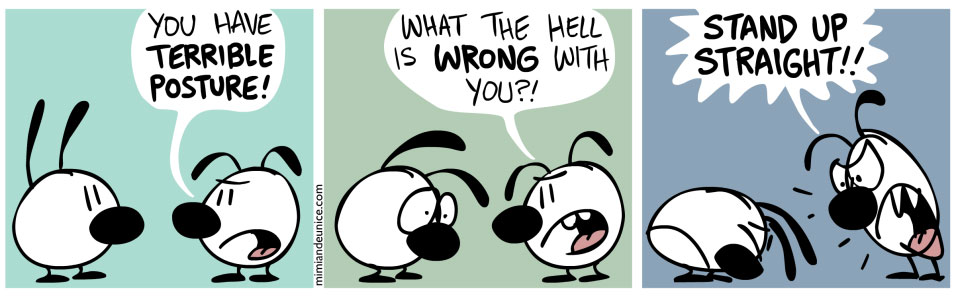
It was about 5 years ago where I found myself absolutely dumbfounded walking into a gym where two S&C Coaches happened to be having a conversation with their athletes about this thing called “posture”, of which up until that moment I thought was confined to chairs and tables. Never in a hundred years would I have ever thought of hearing that word “posture” in a gym. As from my understanding, gyms are places where you see are heavy amounts iron and rubber being thrown around by well-tuned athletic specimens. Needless to say, I would never be the same again.
No matter where you are and what you are doing at this moment, after reading the first few sentences you must be thinking, “well what is posture then?” and “Why is posture important?”.
In a nutshell “posture” refers to your body’s position and more specifically, the alignment of the head, shoulders, hips and other joints (knees and ankles). Watson (1995) describes “good posture” as, “a situation when the centre of gravity of each body segment is placed vertically above the segment below”. Posture is basically standing up tall and sitting up straight? Pretty simple then is it not? Or maybe is it just the tip of a very big iceberg? let’s dive a bit deeper then.
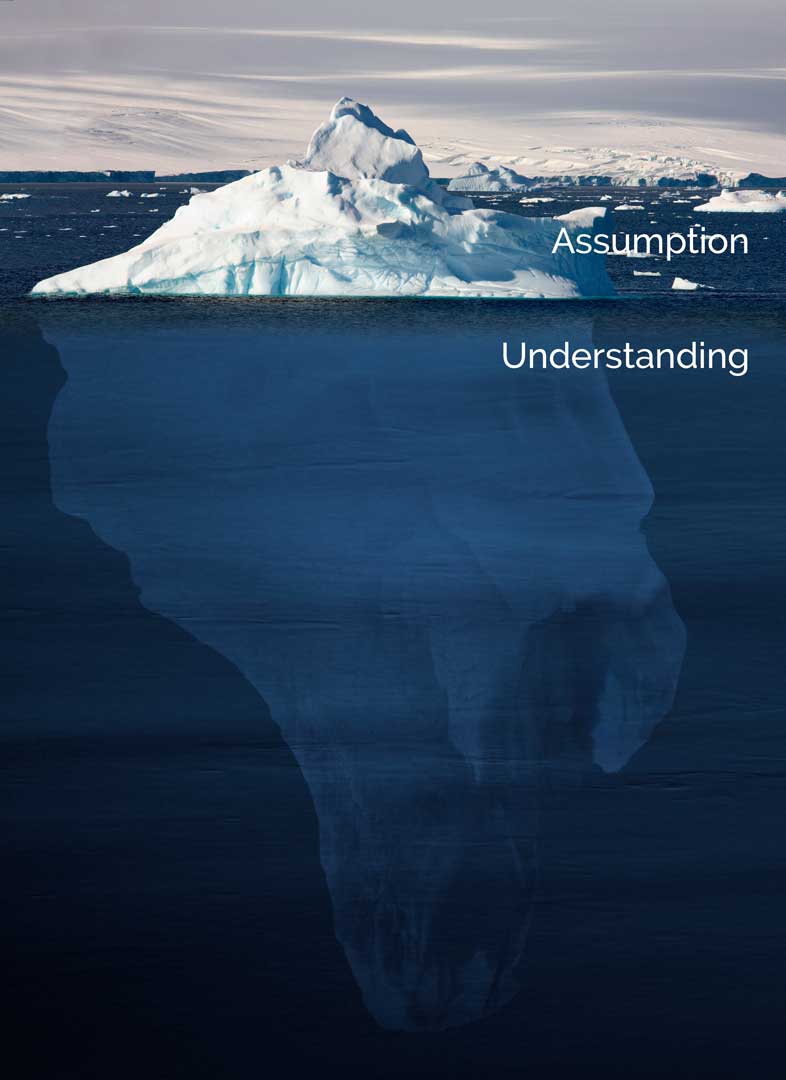
Some of the original work carried out on trying to understand human posture was done by the Greek Physician Galen of Pergamon (129-210 AD) (Ivanenko and Gurfinkel, 2018). Since then it has slowly but surely gained some momentum and evolved to becoming an integral part in both understanding and improving human movement, as well as sports performance
However, before we carry on and jump too far down the rabbit hole, like most popular discussion points in sports science it is important for us to use the proper terminology and provide some context when discussing this topic. In terms of context the following can be said.
- Every day we as human beings are required to use movement to perform general activities of daily living, whether it is at school, work, home or on the sports field/track.
- These activities contribute to our survival, development/growth, and performance, which includes people from all walks of life (general population and athletes).
Considering the above, posture can be observed in a variety of situations, the most likely of all being either “static” or “dynamic”.
Static posture relating to body positions we may be in for longer periods of time/or at rest such as standing, sitting, or sleeping.
Dynamic posture on the other hand is the body’s position and the changes thereof observed during various forms of activity (ie, resistance training, sports specific movement, running etc). If you do think about it carefully, we probably do spend a large portion of our lives in what would be classified/observed as “dynamic posture”, even if it is at very slow speeds and in situations with some relative degree of stability (ie. Standing up to get milk from the fridge may be observed as dynamic posture).
In addition to understanding these two broad trains of thought, in an article written by Carl Valle (2019), he describes posture quite well, “Posture is a head-to-toe expression and representation of the way our body manages gravity and the response to activities that place demand on the body, and also includes what we express to the outside world”. This implies that posture is both static and dynamic in nature, and the way in which we express posture is a product of the various daily demands we are exposed to. More importantly though, that no matter who you are, your profession, lifestyle or type of sport you participate in, posture (whether static or dynamic) plays an integral role in how we execute and react to those demands placed on our bodies.
Good vs Evil? Perfect vs Poor Posture?
As mentioned previously, there is a general assumption that most of us have a general idea of what “good posture” is, however accompanying this is thought that everything but “good posture” is considered “poor”.
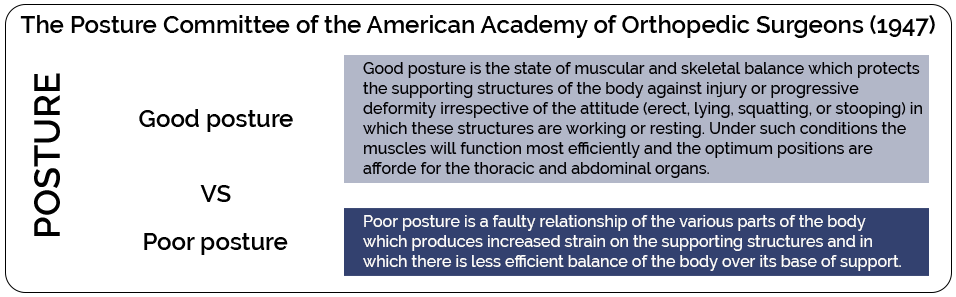
The problem yet again these terms are extremely vague, and probably require more context. As stated by Kendall and colleagues (1993), “good posture” is defined as “a state of musculoskeletal balance that involves a minimal amount of stress or strain to the body” (Kendall. et al, 1993).
Thankfully, The Posture Committee of the American Academy of Orthopedic Surgeons in America have provided considerable content and literature in the goal of further understanding posture (Figure.1). According to the American Posture Institute, “Our posture is the adaptation of our body to the environment in which we live. Everybody has a posture that defines the framework of his or her body’s design”.
Below is an image depicting the various types of adverse/poor posture in a standing position, and their unique patterns of structure and alignment.
Note that these forms are and should not be limited to one joint or structure, and that they often occur in conjunction with changes either upwards or below the in the kinetic chain. In the following examples, make sure to look at the whole body (including the head, spine, hips, and knees) and try to look at patterns in the various forms that may arise, as opposed to observation being made in isolation (ie just the spine/hips).

Now that we have an understanding to some degree of what posture is, as well as some of the forms and/or deviations that exist, the next questions are likely to be;
- How does one either maintain or achieve good posture?
- How do we succumb to adverse and poor forms/deviations of it?
- What is the importance of posture in the realm of sports performance?
- Is posture based on a nature vs. nurture effect?
- Is it a product of your environment or circumstances?
- Is posture different in general vs. athletic populations?
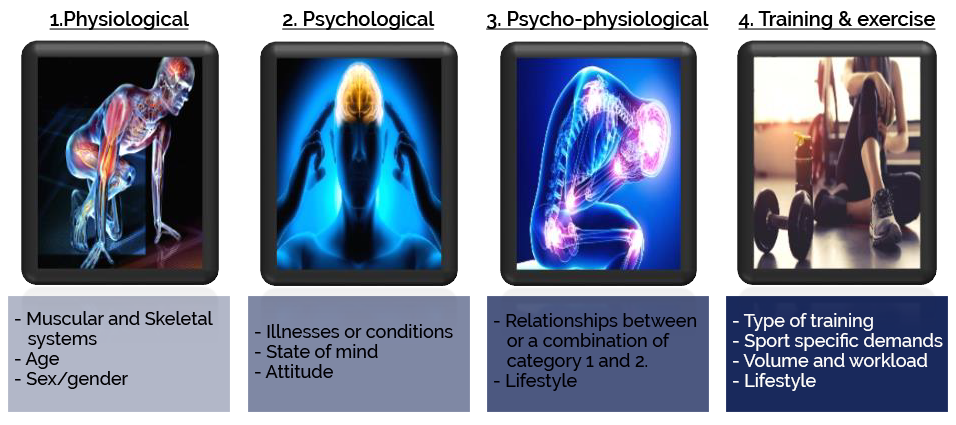
Leading on from the above questions, it is important to note that posture is said to be influenced by several factors, such as those mentioned in Figure 1. As a result, it is very individualistic and can be quite complex when trying to get to the root and underlying causes.
Broadly speaking these factors can be organized in 4 categories; physiological, psychological, psycho-physiological and training/exercise, and like most things in our field and in life it would be naïve to view these factors in isolation. In closing, it is suggested that unless caused by an under-lying condition/illness (which should be diagnosed by medical professional), most factors of poor posture are interrelated and should be viewed she be viewed holistically.
Take home points:
- Posture is an integral part of our daily living and in how we perform various activities and has been for centuries.
- It can be observed in either “static” or “dynamic” situations.
- There are various forms (good and poor) of posture.
- It is complex in nature and requires a multifactorial approach when assessing or attempting to change it.
In our follow up to Part 1 of this series, we will tackle the following in more detail,
- Types of posture and how to assess posture
- Causes and effects of poor posture
In closing here as we attempt to this topic applicable to all, which includes couch-potatoes, weekend warriors and elite athletes, here is a great quote which should stimulate some thoughts regarding posture and its role in sport.
“When the system works efficiently, the result is appropriate distribution of forces; optimal control and efficiency of movement; adequate absorption of ground-impact forces; and an absence of excessive compressive, translation, or shearing forces on the joints of the kinetic chain” - Fredericson & Moore, 2005
Reference List:
- American Posture Institute. 2016. Posturology: A Scientific Evaluation of Postural Alignment.
- Fredericson M, Moore T. 2005. Muscular Balance, Core Stability, and Injury Prevention for Middle and Long-Distance Runners. Phys Med Rehabil Clin N Am 16; pg. 669-89.
- Ivanenko, Y. and Gurfinkel, V., 2018. Human Postural Control. Frontiers in Neuroscience.
- Kendall F, McCreary E, Provance P. 1993. Muscle testing & function. Baltimore: Williams and Wilkins, 50: pg. 685-90.
- Valle, C., 2019. The Influence of Athlete Posture on Sports Performance - SimpliFaster. [online] SimpliFaster.
- Watson AWS. Sports injuries in footballers related to defects of posture and body mechanics. J Sports Med Phys Fitness. 1995; 35:289-94.